Councillor Sheikh Jaw of Banjul City Council (BCC) raised significant concerns last Thursday regarding the financial viability of a proposed digital parking management system partnership between the Council and Innovii Gambia. The councilor questioned the economic justification for the draft Memorandum of Understanding (MoU), which includes a 60-40 revenue-sharing formula in favor of Innovii Gambia. These concerns were initially brought to light during the Banjul City Council meeting held last Thursday, where the proposed agreement was a central topic of discussion.
The draft Memorandum of Understanding (MoU) outlines a full digital parking management system partnership, aiming to modernize and streamline parking operations within Banjul. Under this proposed arrangement, Innovii Gambia would be responsible for implementing and operating the digital system, while the Banjul City Council would participate in the revenue generated. However, the specific terms of this revenue distribution, particularly the 60-40 split, became a focal point of Councillor Jaw's critique.
Councillor Jaw stated, "The MoU is well drafted legally, but requires significant strengthening before execution." He elaborated that while it established "a sound legal framework," it "fell short on governance, value for money, procurement assurance and protection of the Council’s interest." This full critique showed a belief that despite its legal structure, the document did not adequately safeguard the municipality's financial and operational well-being. Jaw specifically noted, "The 60-40 percent revenue-sharing ratio is not supported by any financial and economic justification," adding there was "no evidence of projected revenue, projected cost, return on investment or benchmarking against comparable arrangements." He pressed for a feasibility study, value for money analysis, financial model, and risk assessment to accompany the MoU, arguing these documents are essential for a transparent and economically sound agreement. Jaw also noted that Innovii would control revenue collection, potentially exposing the Council to "financial accountability risk."
Concerns Over Revenue Sharing
Under the proposed agreement for the digital parking management system, Innovii Gambia would retain 60 percent of the net revenue generated. The Banjul City Council would receive the remaining 40 percent of this net revenue. Net revenue is defined in the draft Memorandum of Understanding (MoU) as the income remaining after deductions for items such as taxes, statutory levies, and transaction charges. This definition means that the 60-40 split would apply to the income after these mandatory financial obligations have been met, further emphasizing the importance of the initial revenue projections and cost analyses.
Councillor Sheikh Jaw articulated concerns that the draft MoU lacked key financial documentation to support this revenue allocation. He stated that the document was not accompanied by evidence of projected revenue, which is fundamental for understanding the potential financial gains for both parties. He pointed out the absence of detailed implementation costs, making it difficult to assess the financial burden and efficiency of the proposed system. An assessment of the return on investment was also missing, which Councillor Jaw argued is vital for determining the long-term profitability and economic wisdom of such a partnership for the Council. Councillor Jaw noted the absence of any benchmarking against similar arrangements in other contexts to justify the proposed revenue split. He questioned how the 60-40 revenue-sharing ratio was determined without these comparative analyses, which could provide valuable insights into industry standards and best practices for similar digital parking initiatives. The concerns were raised as of the publication date, July 13, 2026.
Draft Agreement Deficiencies
Councillor Sheikh Jaw recommended that the draft agreement for the digital parking system be referred to the Banjul City Council's legal retainer for further review and enhancement. This recommendation stemmed from his full assessment of the document's shortcomings, both in its financial provisions and its structural integrity. The councilor expressed particular concern that Innovii Gambia controlling revenue collection before remitting the Council’s share could expose the municipality to significant financial and accountability risks. This arrangement, he suggested, could create a lack of transparency and make it challenging for the Council to independently verify the accuracy of the reported net revenue and its allocated share.
Jaw also identified several drafting deficiencies within the Memorandum of Understanding itself. These included incorrect numbering in various sections, which can lead to confusion and misinterpretation of clauses within a legal document. He also pointed out multiple grammatical errors, which, while seemingly minor, can undermine the professional credibility and legal precision of the agreement. He noted repeated references to the 'County of Banjul' instead of the appropriate 'City of Banjul'. Such inaccuracies, he indicated, could undermine the document's legal clarity and effectiveness, potentially leading to ambiguities in jurisdiction or identity that could be problematic in future legal contexts.
Councillor Jaw observed that the draft MoU lacked key governance provisions. Specifically, he noted the absence of explicit clauses pertaining to anti-corruption measures, which are essential for preventing illicit activities and ensuring ethical conduct in public-private partnerships. He also noted the omission of conflict-of-interest disclosures, which are vital for ensuring that decisions are made in the best interest of the Council and its constituents, free from personal biases or hidden agendas. These omissions, according to Jaw, represent significant gaps in protecting the Council's interests and ensuring transparency in the proposed partnership, raising questions about the robustness of the oversight mechanisms embedded within the agreement.
Mayor's Stance and Next Steps
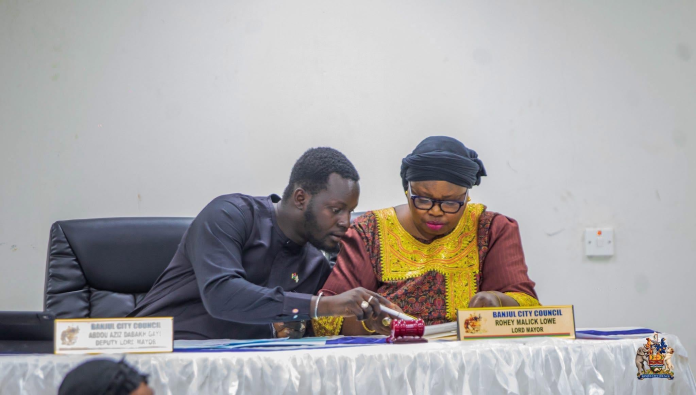
Mayor Rohey Malick Lowe stated that the issues raised by Councillor Jaw would not alter the document, asserting, "This cannot be compared with an AI-generated analysis or whatever." Her firm stance indicated a commitment to proceeding with the current draft, despite the detailed criticisms. The Mayor referred councillors to a separate contract agreement between Innovii Gambia and the Banjul City Council, which she indicated had already received legal sanction. This separate agreement, she implied, provided the necessary legal and financial backing for the partnership, suggesting that the MoU served a different, more informational purpose. She emphasized her commitment to proceeding with the existing arrangement, stating, "To be honest, I am going through with the contract and that is what we should do, meaning Council."
The Mayor explained that the purpose of presenting the Memorandum of Understanding (MoU) was solely to inform councillors, not to seek a resolution approving it. This clarification suggested that the Council's role in this stage was primarily to acknowledge the agreement rather than to deliberate on its terms for approval. However, councillors informed Foroyaa that they had only been provided with the draft MoU during the meeting and not the separate contract agreement mentioned by Mayor Lowe. This discrepancy in access to key documents raised further questions among the councillors regarding the transparency of the process and their ability to fully understand the implications of the partnership. The lack of prior access to the contract agreement meant that councillors were unable to conduct a thorough review of the complete legal framework governing the digital parking system partnership before the meeting.