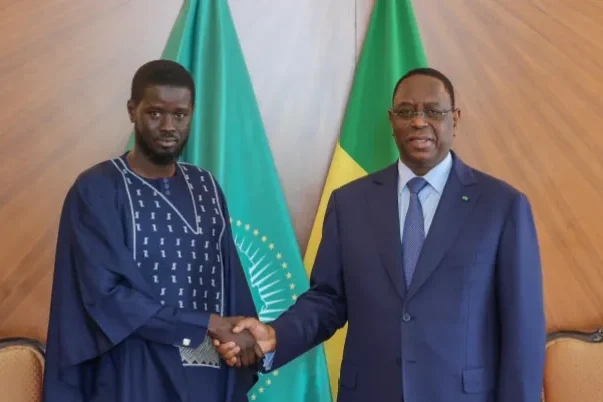
President Bassirou Diomaye Faye of Senegal stated he was not directly informed by former President Macky Sall about Sall's candidacy for UN Secretary-General, learning of it instead from foreign ministers. Mr. Faye indicated that a minister from Central Africa, sent to Dakar, was among the officials who informed him of the candidacy. "I learned of Macky Sall’s candidacy from my four counterparts. He never spoke to me about it," President Faye said, adding, "It is up to Macky Sall to tell me about his candidacy." He also mentioned that Senegal would not accept this type of treatment. "Senegal will never accept this kind of treatment," Mr. Faye asserted, claiming no candidacy had been officially submitted to the African Union. Current candidates for the UN top post include Argentina's Rafael Grossi, Chile's Michelle Bachelet, Costa Rica's Rebeca Grynspan, and Senegal's Macky Sall.
Pressure and Procedure Concerns
President Bassirou Diomaye Faye revealed he felt pressure two days before the African Union summit to endorse Macky Sall's candidacy, according to reports. He also learned that Burundi had submitted Mr. Sall's candidacy without informing him directly. Mr. Faye stated that a silent, 24-hour procedure cannot be imposed illegally, adding that Senegal and other countries have not accepted this approach. Despite concerns, Mr. Faye indicated he would not obstruct efforts to support his predecessor's candidacy.
Macky Sall, a former president of Senegal, has stated the UN needs to "regain its place at the global table," vowing to be a "bridge-builder" who would "contribute to restoring trust, to calm tensions, reduce fragmentation and breathe renewed hope into our collective action." His proposed "reinvented role" for the UN addresses what he termed a "human tragedy." Mr. Faye noted that a specific committee manages the candidacy matter within the African Union. Rafael Grossi, the current head of the International Atomic Energy Agency, also a candidate, commented on "how fragile the UN is today," adding "there are enormous, huge doubts about our institution" and "We have to concentrate on that."
UN Secretary-General Selection Process
Four candidates contending to replace UN Secretary-General Antonio Guterres were questioned for hours in New York this past week about their views on global issues and leadership. Each candidate spent three hours answering questions from the 193 member states and representatives of civil society as part of the selection process for the chief administrative position. General Assembly President Annalena Baerbock presided over these question-and-answer sessions.
Rafael Grossi, the current head of the International Atomic Energy Agency, stated that "there are enormous, huge doubts about our institution" and its ability to deal with global problems, adding, "how fragile the UN is today." Reports indicated that no clear frontrunner has emerged so far in the race to succeed Guterres, whose term ends on January 1. All four candidates said they would focus on the UN's three pillars: ensuring international peace and security, protecting and upholding human rights, and fostering development, and all pledged to enable reforms.
Chilean candidate Michelle Bachelet, a two-time president of Chile and former UN human rights chief, told ambassadors that the UN must try to avoid crises and that she possesses the necessary leadership skills. Rebeca Grynspan, a former vice president of Costa Rica and the secretary-general of the UN trade and development agency, stated she would "continue to be the moral voice and the impartial voice that the secretary-general has to be." Grynspan wrote in her vision statement that "the United Nations, the world needs must be the cornerstone of our collective mission." She views the shortcomings of the UN as a result of institutional risk aversion, saying, "We need to take more risks - and I am ready to fail and try again." Traditionally, the role of secretary-general rotates on a regional basis, and this election marks Latin America’s turn. Reports indicated Bachelet is facing a potential Security Council veto from US Secretary of State Marco Rubio over her stance as a "pro-abortion zealot," according to some US lawmakers.
Candidates' Visions and Challenges
Four candidates are hoping to succeed Antonio Guterres as UN secretary-general. Daniel Forti, the International Crisis Group’s head of UN affairs, stated, "It is not immediately obvious whether any candidate did enough to propel themselves ahead of the others, or to ward off potential challengers who might emerge later." The decision rests with the UN Security Council, which will choose a candidate for final approval by the General Assembly. The General Assembly elects the secretary-general upon the Security Council's recommendation. The five permanent members of the Security Council—the United States, China, Russia, Britain, and France—hold veto power.
UN official Susana Malcorra asserted the UN needs new leadership and energy "more than ever." The UN faces questions about its relevance and is "teetering on the brink of financial collapse" amidst armed conflict. US President Donald Trump has called for the UN to return to its "original mission" of peace. Chile's Michelle Bachelet, a former UN human rights chief, said the secretary-general should be "physically present in the field" wherever problems need solving. Rebeca Grynspan, as head of UN Trade and Development, previously negotiated the export of Ukrainian grain after the 2022 Russian invasion. When asked about Gaza, Grynspan urged "unrestricted" entry of humanitarian aid and supported a long-term solution for two states to live side-by-side in "peace and security." The question-and-answer sessions, known as "interactive dialogues," were introduced in 2016.