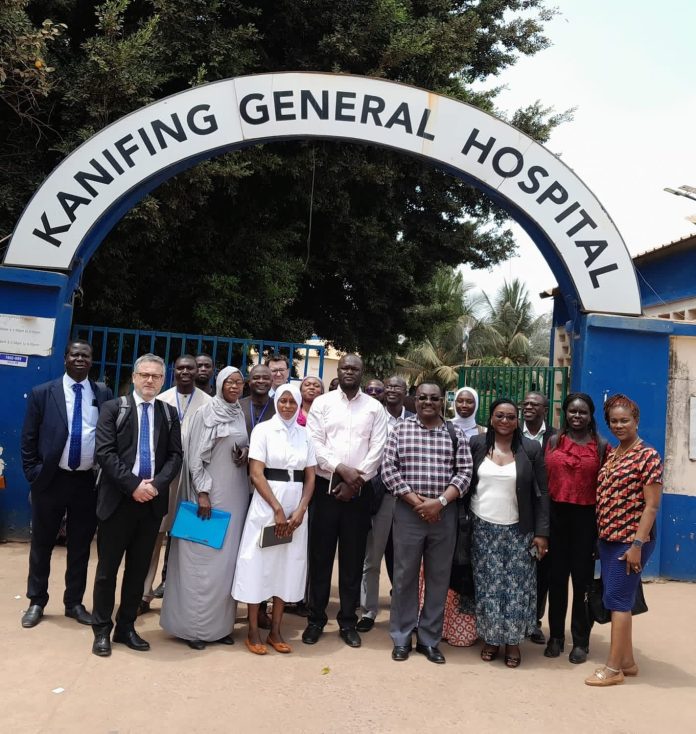
Kanifing General Hospital has refuted recent claims circulating on social media alleging that it charges blood donors D300 to donate blood. The hospital stated that these claims are false and do not reflect its blood donation policy, expressing concern that such information could discourage voluntary blood donation and erode public confidence in the healthcare system. Kanifing General Hospital (KGH) has dismissed these claims circulating on social media that it charges blood donors D300 to donate blood. "We wish to clarify that this claim is false and does not accurately represent the Hospital’s blood donation policy," Kanifing General Hospital said. The hospital emphasized that misleading information circulating online could indeed discourage voluntary blood donation and erode public confidence in the healthcare system, which relies heavily on community trust and participation.
The hospital clarified that individuals who voluntarily donate blood to support its blood bank are not required to pay any fee. "Voluntary blood donation remains a vital public health intervention, and KGH deeply appreciates the generosity and selflessness of all voluntary donors," the hospital added. It explained that blood grouping and cross-matching fees of D200.00 and D300.00, respectively, are charged to the patient requiring the transfusion, not to the donor. "As a result, the standard laboratory charges for blood grouping and compatibility testing were applied in accordance with the approved Ministry of Health User Fee Policy," the hospital stated, emphasizing that these charges were for patient laboratory services and not for the act of donating blood. At no point was the blood donor asked to pay for making a blood donation, the hospital firmly asserted.
Clarifying Donation vs. Patient Fees
Kanifing General Hospital affirmed that blood donors are not charged for the act of donating blood. The hospital clarified that individuals who voluntarily contribute blood to its blood bank to assist in emergency situations are exempt from any fees. Kanifing General Hospital stated, "Individuals who voluntarily donate blood to support the Hospital’s blood bank and help save lives in emergency situations are not required to pay any fee whatsoever. Voluntary blood donation remains a vital public health intervention, and KGH deeply appreciates the generosity and selflessness of all voluntary donors." This policy ensures that the act of giving blood remains a selfless and unburdened contribution to public health.
The hospital further explained that any charges encountered are related to laboratory services for patients, not for the donation itself. According to the hospital, standard laboratory charges for blood grouping and compatibility testing were applied in adherence to the Ministry of Health User Fee Policy. These fees are specifically for the processing and testing of blood for patient use, ensuring compatibility and safety for the recipient. The hospital emphasized that these are patient-side laboratory costs and do not pertain to the voluntary donor. The charges were levied in relation to the patient’s laboratory services and not as a fee for the donor donating blood, a key distinction that the hospital aims to make clear to the public.
Context of Patient Charges
Kanifing General Hospital clarified that specific fees are applied to patients receiving blood transfusions, not to individuals donating blood. "Blood grouping and cross-matching fees of Two Hundred Dalasis (D200.00) and Three Hundred Dalasis (D300.00), respectively, are charged to the patient requiring the transfusion – and not to the donor," the hospital stated. These charges are related to essential laboratory services for the patient, ensuring blood compatibility and safety for transfusion. The hospital emphasized that these fees are distinct from any payment for the act of donating blood, showing that the hospital's priority is to maintain accessible and safe blood services for all patients in need.
A recent incident that sparked public discussion involved a 22-year-old patient who did not possess a valid National Identification Card when seeking treatment. The patient involved in the incident that generated public debate was a 22-year-old who did not present a valid National Identification Card at the time of seeking treatment. This individual was subject to the standard laboratory service charges. Kanifing General Hospital further explained that exemptions from these fees are available for certain patient groups. Pregnant women, women in labor, and postnatal mothers are exempt from paying these charges, provided they present a valid National Identification Card or a National Health Insurance Card. This policy aims to support vulnerable populations while maintaining the hospital's operational standards for laboratory testing and ensuring that critical services remain available.
Hospital's Stance and Concerns
Kanifing General Hospital issued a statement on July 15, 2026, to address a social media post alleging that prospective blood donors were required to pay D300 before being permitted to donate. In a statement issued on July 15, 2026, the hospital said it was responding to a social media post alleging that individuals wishing to donate blood were required to pay D300 before being allowed to donate. The hospital clarified its position in response to these claims. Kanifing General Hospital emphasized that voluntary blood donation remains a vital public health intervention. The institution expressed deep appreciation for the generosity and selflessness of all voluntary donors. The hospital's statement aimed to counter misinformation that could potentially discourage individuals from contributing to its blood bank, thereby safeguarding the integrity of its blood supply system and public trust. The hospital reiterated its commitment to transparency and urged the public to rely on official channels for accurate information regarding its services and policies.