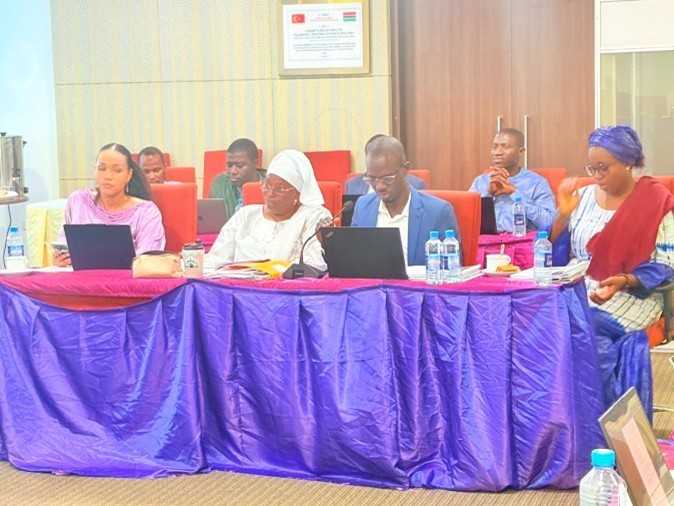
The Petroleum Commission reported generating over US$1 million from upstream petroleum activities during 2025, according to its 2025 Activity Report and Financial Statements. The Commission recorded total receipts of US$1,041,922 from these operations last year. This report was formally presented to the Finance and Public Accounts Committee (FPAC) of the National Assembly on Thursday, 16 July 2026, detailing the Commission's financial performance and operational notes for the preceding year. The presentation to the National Assembly committee shows the commitment to transparency and accountability in the management of the nation's petroleum resources.
The 2025 Activity Report stated that "The total funds made available therefore represent approximately 80 percent of the approved budget allocation." This figure provides key context for understanding the Commission's operational capacity relative to its budgetary needs. It also noted previous efforts to enhance financial oversight, noting, "In 2024, we solidified our financial governance through the submission of the 2023 audited financial statements to the National Assembly." This continuous effort to strengthen financial governance reflects a broader strategic objective to ensure strong and transparent management of public funds within the petroleum sector.
Revenue Breakdown and Sources
Of the total revenue, US$751,922 was generated from the sale of seismic and reprocessed geological data to Woodside and Chevron. These sales represent a significant portion of the Commission's earnings from upstream activities during the reporting period. The datasets purchased by these companies included JAAN 3D Blocks A1, A2, A4, and A5, alongside the MSGBC 2018 dataset. The full nature of these data packages provides valuable insights into the geological potential of the respective blocks, attracting international interest from major industry players. Additionally, reprocessed data for Blocks A1 and A4, originally acquired from BP, were also part of these sales, further enhancing the value proposition for the purchasing entities. The Petroleum Commission received payments for these data sales on March 4 and March 5, 2025, marking timely financial transactions that contributed directly to the Commission's revenue stream. These sales are critical not only for their direct financial contribution but also for facilitating further exploration and development activities in the country's offshore blocks.
Petronor E&P contributed an additional US$290,000 to the commission's revenue, demonstrating another vital income stream from active exploration companies. This contribution was divided into two components: US$185,000 allocated for training and resources, and US$105,000 in surface rental fees. The allocation for training and resources notes the Commission's focus on capacity building and ensuring that local expertise is developed to support the burgeoning petroleum sector. The surface rental fees, on the other hand, represent standard charges for the rights to explore within designated areas. These payments from Petronor E&P specifically relate to the final six months of the first phase of the initial exploration period for Block A4, indicating ongoing operational engagement and financial commitments from the exploration company within this significant offshore block. The consistent flow of such payments is essential for the Commission's financial stability and its ability to fund its regulatory and oversight functions.
Budgetary and Financial Overview
The Petroleum Commission initiated its budgetary process by requesting its approved 2025 budget of D52.319 million from the Ministry of Petroleum and Energy on January 20, 2025. This request outlined the financial resources deemed necessary for the Commission to effectively carry out its mandate for the year. Following this request, the Ministry disbursed D35.465 million on March 24, 2025, providing a substantial portion of the requested funds. An additional balance of D6.233 million was carried forward from 2024, contributing to the Commission's available funds and demonstrating prudent financial management in previous periods. The combination of these disbursements and carried-over funds formed the operational budget for the year.
According to the 2025 Activity Report and Financial Statements, "The total funds made available therefore represent approximately 80 percent of the approved budget allocation." This indicates that while significant funds were released, the Commission operated with a slightly constrained budget relative to its initial requests. The report also noted the Commission's efforts to strengthen financial oversight in previous periods, an ongoing commitment to good governance. "In 2024, we solidified our financial governance through the submission of the 2023 audited financial statements to the National Assembly," the report stated, emphasizing a proactive approach to financial transparency and accountability. For the reporting period, the Commission's financial statements indicated total assets of D232.35 million, reflecting the overall financial health and resources under its management. The gross income for the year was recorded at D42.07 million, primarily driven by the revenue streams from data sales and operator contributions. However, total expenditures reached D50.78 million, resulting in a deficit for the year. This deficit notes the financial challenges faced by the Commission in meeting its operational costs, even with significant revenue generation from upstream activities, and shows the importance of continued financial support and efficient resource allocation.
Comparative Performance and Economic Impact
In 2024, the Commission generated US$1,097,853 in upstream petroleum revenue, providing a comparative figure to the 2025 total of US$1,041,922. This comparison shows a slight decrease in direct revenue from upstream activities year-over-year, which could be attributed to various factors such as the timing of data sales or exploration phase transitions. That same year, the Commission submitted its 2023 audited financial statements to the National Assembly, reinforcing financial governance and ensuring public scrutiny of its financial performance. This consistent reporting mechanism is vital for maintaining trust and accountability within the sector.
Beyond direct revenue, petroleum operators contributed significantly to the local economy. In 2023, these operators spent US$1,468,810 on upstream petroleum activities within The Gambia. This substantial investment demonstrates the broader economic benefits derived from the presence of international petroleum companies, including job creation, local procurement, and service utilization. The Commission's 2022 report noted its cumulative financial contributions, stating it had generated US$6.31 million in accumulated direct revenue for the Government from upstream petroleum activities up to that point. This cumulative figure illustrates the long-term financial impact of the Commission's efforts in attracting and managing petroleum exploration. Additionally, indirect spending injected US$313,927 into the Gambian economy during 2022, demonstrating broader economic engagement from the sector. This indirect spending, which includes expenditures on local goods, services, and infrastructure, further amplifies the positive ripple effect of petroleum operations, supporting various local businesses and contributing to national economic development. The holistic view of both direct and indirect contributions shows the multifaceted economic importance of the petroleum sector to The Gambia.