The 2022 National Audit Office management letter examined the contract for the administration and management of immigration-security services at Banjul International Airport. Officials conducted this review to evaluate the operational and financial terms governing the provision of these services within The Gambia. The audit focused on the formal agreement established for the oversight of security technology and immigration processing infrastructure at the facility. By assessing the contractual obligations, the National Audit Office sought to determine the adherence of the parties to the specified service requirements. This evaluation forms part of the ongoing oversight of government-related technology contracts at the airport. The document specifically scrutinized the 2022 National Audit Office management letter, which served as the primary instrument for reviewing the contract for the administration and management of immigration-security services at Banjul International Airport.
System Capabilities and Functionality
The Gambia Immigration Department utilizes an Integrated Immigration Control System to process travelers at Banjul International Airport. This technology captures biometric data including fingerprints and iris scans, alongside information from the data-page of a traveler’s passport. The Integrated Immigration Control System serves as the core technological framework for the department, ensuring that the processing of individuals entering or exiting the country is handled through standardized digital protocols. By utilizing this specific Integrated Immigration Control System, The Gambia Immigration Department aims to streamline the verification of travelers, relying on the collection of fingerprints, iris scans, and passport data-page information to maintain security standards at the border.
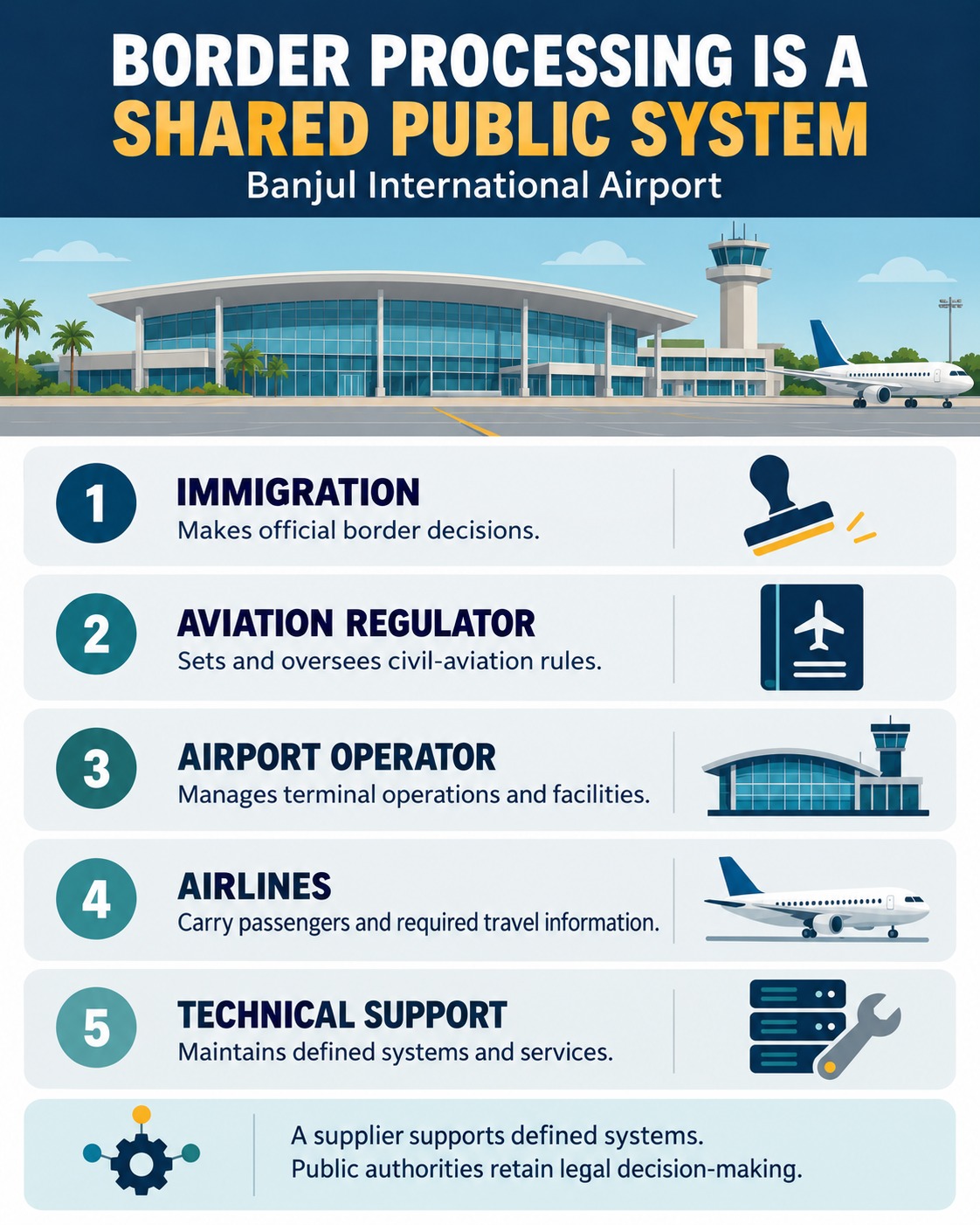
Securiport manages the implementation of this system at the facility. The company also provides training for personnel, ongoing system maintenance, and technical assistance to government clients operating the infrastructure. Beyond the initial deployment, Securiport provides system implementation, training, maintenance, and technical assistance to government clients to ensure the long-term viability of the security equipment. These services are essential for the daily operations of the Integrated Immigration Control System, as they allow the staff to remain proficient in the use of the technology while ensuring that any technical issues are addressed through the maintenance and technical assistance provided by Securiport.
Securiport maintains that governments operate the installed systems independently. According to the company, these government clients retain full ownership of their data and possess the decryption keys required to access the information captured by the system. As part of its operational policy, Securiport states that governments operate the installed systems and retain ownership of their data and decryption keys. This separation of roles is intended to ensure that while Securiport provides the technical infrastructure and support services, the sovereign entity remains in complete control of the sensitive information gathered at the airport. By maintaining ownership of the decryption keys, the government ensures that the data captured by the Integrated Immigration Control System remains under its exclusive jurisdiction, consistent with the claim that Securiport states that governments operate the installed systems and retain ownership of their data and decryption keys. This framework governs the relationship between the service provider and the government clients as they utilize the infrastructure at Banjul International Airport.