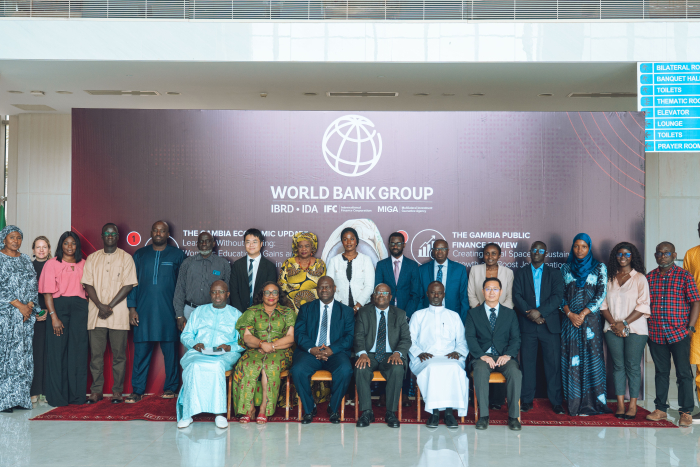
The World Bank Group recently released two full reports focused on The Gambia's economic landscape: "The Gambia Economic Update: Learning Without Earning: Women's Educational Gains and Labor Market Constraints in The Gambia" and the "Public Finance Review (PFR) titled ‘Creating Fiscal Space to Sustain Growth and Boost Job Creation.’" These documents meticulously analyze the country's economic standing, providing an in-depth look at its progress and noting critical areas for continued development. According to the reports' detailed findings, The Gambia has achieved a notable reduction in extreme poverty, which decreased from 21.5% to 20.3%. The World Bank Group's assessments offer a key overview of the nation's advancements while simultaneously identifying persistent economic challenges that demand strategic attention and policy intervention. These insights are designed to inform policymakers and stakeholders about the most effective pathways to sustainable growth and improved livelihoods across the country.
Economic Growth and Poverty Reduction
The Gambian economy is projected to experience a significant growth acceleration, with figures rising robustly from 5.6% in 2024 to an estimated 5.9% in 2025. This promising upward trend follows a period of consistent expansion that the nation has enjoyed since its democratic transition. The Public Finance Review, one of the key documents released, indicates that The Gambia has achieved an impressive average annual Gross Domestic Product (GDP) growth rate of 5% since 2017. This sustained economic performance shows the resilience and potential of the Gambian economy. Further evidence of this positive trajectory is reflected in the decline of extreme poverty, which saw a reduction from 21.5% to 20.3%. This progress in poverty alleviation is a critical indicator of improving living standards for a segment of the population.
A key contributor to this overall economic performance and growth has been the vibrant tourism sector. The nation saw a substantial increase in tourism arrivals, climbing from 224,472 to 233,113. This growth in visitor numbers not only boosts foreign exchange earnings but also supports the broader economic development trajectory outlined in the World Bank Group's assessments, creating jobs and stimulating local businesses. The continued expansion of tourism is seen as a vital component in The Gambia's strategy for economic diversification and sustainable development.
Persistent Job and Gender Gaps
Despite the encouraging economic growth, The Gambia faces significant structural challenges, particularly within its labor market and concerning persistent gender disparities. A substantial 81% of workers in The Gambia are employed in the informal sector, according to the World Bank reports. This overwhelming dominance of the informal sector contributes to a high rate of youth not engaged in employment, education, or training (NEET), affecting 41.3% of individuals aged 15 to 34. The lack of formal employment opportunities and pathways for young people represents a significant hurdle to harnessing the demographic dividend and ensuring long-term economic stability.
The reports indicate a notable gender gap in labor force participation, noting unequal opportunities. Women's participation stands at 41.9%, while men's is significantly higher at 54.9%. The informal sector disproportionately affects women, with 78.1% of women in The Gambia working informally. This disparity in employment conditions is compounded by a significant wage gap, revealing economic inequality. Women in The Gambia earn an average of 31.5 Gambian Dalasi (GMD) per hour, considerably less than the 42.4 GMD per hour earned by men for comparable work. This wage differential further exacerbates economic vulnerability for women and their households.
Interestingly, educational outcomes for girls show stronger performance at primary and lower-secondary levels, where they consistently outperform boys. However, this academic achievement does not consistently translate into equitable labor market opportunities, noting a critical disconnect that the World Bank reports identify as a key area for urgent policy intervention. The prevalence of informal work, coupled with the persistent wage differential and lower labor force participation for women, shows the pressing need for targeted strategies to improve job quality, promote gender equity, and ensure that educational gains translate into meaningful economic empowerment in The Gambia's economy. Addressing these gaps is key for inclusive growth and poverty reduction.
Fiscal Vulnerabilities and Reform Agenda
Public debt in The Gambia is projected to reach approximately 76.4% of GDP in 2025, according to World Bank reports. The country's fiscal deficits have averaged 4.5% of GDP, indicating a consistent imbalance between government spending and revenue. Simultaneously, tax revenue recorded an average of 10.3% of GDP between 2017 and 2024, a figure that suggests considerable room for improvement in domestic resource mobilization. These combined figures highlight persistent fiscal vulnerabilities that necessitate a full and urgent reform agenda to ensure long-term economic stability and sustainability. The high debt burden and limited fiscal space constrain the government's ability to invest in critical public services and infrastructure.
The World Bank's proposed reform agenda for The Gambia includes several key strategic measures aimed at strengthening public finances and creating fiscal space for growth-enhancing investments. These measures include broadening the tax base to capture more economic activity and digitizing revenue administration to enhance efficiency and reduce leakage. Another key aspect involves replacing generalized subsidies, which often benefit wealthier segments of society, with more targeted transfers to improve social equity and reduce fiscal strain. The operationalization of the 2023 State-Owned Enterprises Act is a vital part of the recommended reforms, aiming to improve governance and financial performance of state-owned entities.
World Bank analysis indicates that closing existing gaps across key tax instruments could unlock an additional 3–4% of GDP in revenue for The Gambia, providing substantial resources for development. Additionally, implementing full wage bill reforms could generate significant savings equivalent to 2.6% of GDP between 2025 and 2029, which could then be strategically redirected towards productive investments in human capital and infrastructure. These reforms are essential for The Gambia to achieve fiscal sustainability, reduce its reliance on external financing, and foster an environment conducive to sustained economic growth and job creation.