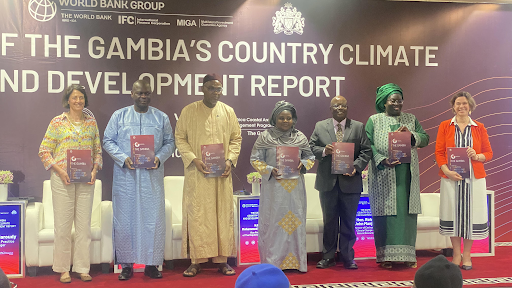
The Gambian capital, Banjul, risks being inundated by rising sea levels, according to findings released in a new report this week. The "Country Climate and Development Report (CCDR)" was launched on Tuesday at the Sir Dawda Kairaba Jawara International Conference Centre. The Gambian government, represented by the Ministry of Finance and Economic Affairs and the Ministry of Environment, Climate Change and Natural Resources, officially presented the report. The CCDR, a flagship publication of the World Bank Group, details the significant environmental challenges facing the coastal city. The report specifically warns that the Gambian capital, Banjul, is at risk of being overtaken by rising sea levels, posing an existential threat to the city.
Broader Climate Impacts on The Gambia
Climate hazards are already impacting livelihoods and the outcomes of public investments in The Gambia, indicating a growing vulnerability to flooding, coastal erosion, and other environmental shocks. These hazards highlight an increasing exposure to various climate-related challenges across the nation. Climate change is emerging as a significant constraint on the nation's development trajectory, according to the report. This means that addressing climate change is not merely an environmental concern, but a critical factor in achieving The Gambia's broader development goals. Without immediate and decisive action, climate change has the potential to reduce The Gambia’s Gross Domestic Product (GDP) by as much as 9.3 percent by 2050. This potential economic contraction shows the urgency of implementing strong climate mitigation and adaptation strategies. Similarly, natural disasters and associated shocks could diminish the country’s GDP by up to 9.3 percent by 2050 if a business-as-usual pathway is maintained. This scenario projects a future where current practices continue without significant changes in policy or investment towards climate resilience.
Coastal assets with a value exceeding 90 percent of the GDP are at risk under scenarios involving significant sea-level rise. This statistic emphasizes the profound economic vulnerability of The Gambia's coastal regions, where much of the country's infrastructure and economic activity are concentrated. The "Country Climate and Development Report" (CCDR) incorporated insights from extensive consultations with government officials, representatives from the private sector, civil society organizations, and various development partners. This full consultation process ensured that the report's findings and recommendations are well-informed and reflect a wide range of perspectives from key stakeholders. The report identifies several key actions necessary to address these challenges. These include scaling up renewable energy initiatives, strengthening infrastructure to be more resilient to climate impacts, and improving practices for land and water management. Each of these actions is designed to build The Gambia's capacity to withstand and adapt to the effects of climate change. Additionally, the report emphasizes the importance of supporting private sector-led growth to drive sustainable development. Engaging the private sector is seen as key for mobilizing resources and innovation towards climate solutions and green economic growth. Aligning climate action with the country's broader national development priorities could significantly help in reducing overall vulnerability, protecting economic gains already achieved, and supporting long-term growth for The Gambia. This integrated approach ensures that climate resilience is not treated as a separate issue but is woven into the fabric of national development planning.
Urgent Need for Action and Adaptation
Protecting Banjul, The Gambia's capital city, has been identified as an urgent priority in addressing the country's climate vulnerabilities. The recent "Country Climate and Development Report" (CCDR) emphasizes that proactive measures are critical to safeguard the city, which faces significant threats from rising sea levels and other climate hazards. This focus on Banjul shows the immediate need for strategic interventions to avert potential catastrophic impacts. The report explicitly states that urban and coastal areas, particularly Banjul, are among the most exposed to the adverse effects of climate change. This heightened vulnerability is due to a combination of geographical factors and the concentration of population and economic assets in these areas.
The report notes that timely investments in adaptation measures and "no-regret" strategies have the potential to significantly reduce projected economic losses. By implementing such strategies, The Gambia could cut these anticipated losses by more than half, thereby protecting its economic stability and development gains. These "no-regret" strategies are defined as actions that yield benefits regardless of the severity of future climate change, making them sound investments under any climate scenario. Such strategies include measures like improving early warning systems, restoring coastal ecosystems, and enhancing water management practices, all of which offer tangible benefits even in the absence of severe climate impacts. The economic benefits of these proactive measures extend beyond loss reduction, contributing to more stable and predictable development pathways for the nation.
Economic adjustments are also recommended to lessen the country's exposure to climate risks, particularly by redirecting development away from highly vulnerable coastal areas. The CCDR suggests diversifying and expanding economic opportunities inland as a key strategy. This approach aims to reduce the concentration of economic activity and population in areas most susceptible to climate impacts, fostering more resilient and balanced national development. This geographical redistribution of economic activity and population would help to spread risk and reduce the potential for large-scale disruptions from coastal hazards. Such strategic planning is essential for long-term national resilience and sustainable growth.
Official Reactions and Recommendations
Banjul faces significant threats, with approximately 200,000 coastal residents and assets valued at $2.1 billion currently under threat from the impacts of climate change. This substantial figure shows the scale of the human and economic risk concentrated in the capital. A new climate report warns that without decisive intervention, the Gambian capital could be subsumed by rising waters at some point between 2050 and 2100. This stark projection provides a clear timeline for urgent action to protect the city from permanent inundation. The report shows the urgent need for full strategies to protect the city's population and economic infrastructure.
The document notes broader economic ramifications for The Gambia, indicating that climate change has the potential to intensify public debt pressures. This environmental challenge could also impede overall economic growth, potentially pushing tens of thousands of Gambians into poverty. The report emphasizes that these socio-economic consequences are directly linked to the escalating climate crisis. The interplay between climate change and economic stability is a central theme, illustrating how environmental degradation can directly undermine development efforts and exacerbate social inequalities.
Among the various regions within The Gambia, urban and coastal areas, particularly Banjul, are identified as being among the most exposed to the adverse effects of climate change. This vulnerability stems from their geographical location and the concentration of population and economic activity along the coast. The findings point to the critical necessity of prioritizing these areas in national adaptation and mitigation efforts. Addressing the specific vulnerabilities of Banjul and other coastal urban centers is critical for safeguarding both human lives and the nation's economic future. The report's recommendations serve as a roadmap for the Gambian government and its development partners to build a more resilient and sustainable future for the country.