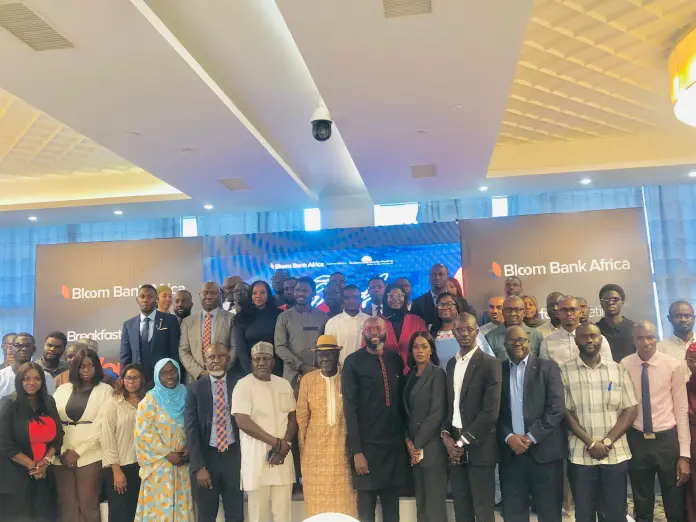
Bloom Bank hosted a breakfast forum on "AI for Finance Professionals" on Tuesday, urging The Gambia’s financial sector to adopt artificial intelligence. The event specifically promoted AI as a key tool to drive efficiency, strategy, and innovation within the industry. The forum noted the considerable potential for AI technologies to transform financial operations and decision-making processes across the West African nation, emphasizing that embracing these advancements is key to future growth and competitiveness.
The AI Imperative for Finance
During the forum, Managing Director Alfred Amoah shared a personal anecdote, recounting how his son utilized artificial intelligence to research his salary. This story served to illustrate the technology's growing accessibility, its practical applications, and its powerful analytical capabilities, even in everyday scenarios. Salifu Bah, in his full presentation, outlined the significant evolution of the financial sector. He meticulously traced its progression from an era of reliance on handwritten ledgers and manual processes, through the adoption of modern Enterprise Resource Planning (ERP) systems and advanced spreadsheets, to its current trajectory towards AI-powered solutions. Bah asserted that the role of a Chief Financial Officer (CFO) has fundamentally transformed over time, shifting from being merely a "guardian of the past" to operating as a "chief strategic partner" within organizations, a role increasingly enabled and enhanced by AI. Olamide Jalaoso further emphasized AI's profound impact, noting that tasks which historically required days to complete can now be executed in a matter of minutes, showcasing a dramatic improvement in operational speed and output. The forum heard compelling evidence that AI tools, including widely recognized platforms such as Microsoft Copilot and ChatGPT, are already being deployed within Gambian offices, indicating a clear and current trend of adoption within the local business landscape. The organizers concluded that financial institutions must proactively adapt to these artificial intelligence advancements or face the significant risk of becoming obsolete in a rapidly changing global financial landscape. This adaptation is not merely an option but a necessity for sustained relevance and growth.
Transforming Roles and Responsibilities
Salifu Bah, Director of Finance in Petroleum at Bloom Bank, stated unequivocally that artificial intelligence transforms the finance profession but will not replace professionals themselves. He articulated this distinction by asserting, "AI replaces tasks, not people," a key message for attendees concerned about job security. Bah further elaborated on this point, adding, "The tasks being automated were never the source of our profession; they were the price of our admission." He emphasized a critical shift in the value proposition for finance professionals in this new era. "Your value is no longer producing the report. Your value is in what happens after the report – the insights, the judgment, the courage to tell leadership what the numbers reveal," Bah explained, showing the move towards higher-level strategic contributions. He also noted the continuing and indeed heightened responsibility of finance professionals in an AI-driven environment, particularly concerning accuracy and compliance. Bah noted that "If AI generates a wrong report, regulators come to finance, not IT. We must be part of that governance process," stressing the need for oversight and accountability. Bah urged attendees to proactively consider their evolving role within their organizations, advising, "Go from this room not asking, ‘Will AI replace me?’ Ask, ‘How do I become the strategic partner my organisation cannot afford to be without?’" This call to action encouraged a forward-thinking approach to career development in the age of AI.
Workshop trainer Olamide Jalaoso conducted a practical session during the forum, demonstrating how to use various AI tools across different job functions within the finance sector. This hands-on segment provided attendees with direct, experiential learning in applying AI to daily tasks and strategic planning, making the theoretical concepts tangible and actionable. The session covered a range of applications, from automating routine data analysis to generating predictive insights, equipping participants with immediate skills to implement in their roles.
Navigating the Future of Finance
Olamide Jalaoso, a workshop trainer, conducted a practical session during the forum, demonstrating the application of various artificial intelligence tools across different job functions within the finance sector. The session provided attendees with direct experience in applying AI to daily tasks and strategic planning, offering valuable insights into the immediate benefits and future possibilities of AI integration. Salifu Bah, Director of Finance in Petroleum at Bloom Bank, previously emphasized that while AI transforms the finance profession, it will not replace professionals themselves. He stated that AI replaces tasks, not people, and that the value of finance professionals now lies in insights, judgment, and strategic partnership rather than mere report production. Bah also noted the ongoing responsibility of finance professionals in an AI-driven environment, particularly concerning regulatory compliance and the critical need for human oversight and governance. Alfred Amoah, Managing Director of Bloom Bank, had earlier shared an anecdote illustrating AI's growing accessibility and its widespread influence, even in personal finance. The forum aimed to encourage The Gambia's financial institutions to embrace AI advancements to ensure future growth, enhance operational efficiency, and avoid obsolescence in an increasingly digitized global economy. The consensus among speakers was clear: the future of finance in The Gambia is inextricably linked to the intelligent adoption and strategic application of artificial intelligence.