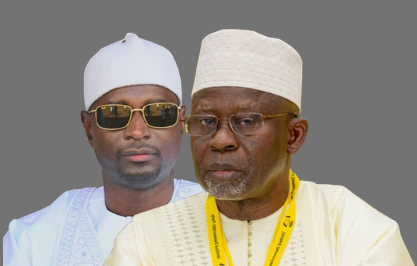
Seedy Njie, deputy spokesperson of The Gambia's National People’s Party (NPP) and deputy speaker of the National Assembly, has refuted claims made by United Democratic Party (UDP) leader Ousainu Darboe regarding the breakup of their alliance with President Adama Barrow. Njie made his comments in a Standard interview, responding to Darboe's assertion that Barrow’s alliance with the APRC party was the "departing point" in his relations with the president. Darboe had told Deutsche Welle (DW) last week that President Adama Barrow’s alliance with the APRC party of former president Yahya Jammeh “was really the departing point” in his relations with Barrow, claiming this was the key reason for the split.
Njie countered Darboe's claim, stating, "But what is funny is that in 2017, Mr Darboe, had engaged a good number of APRC officials including myself to join the UDP." He added that some accepted the invitation while others, like himself, declined. Njie asserted that the UDP’s split with Barrow is factually incorrect to associate or link with the coalition agreement between the APRC and the NPP. "So it is factually incorrect to associate or link the UDP’s split with Barrow to the coalition agreement between the APRC and the NPP," Njie said, dismissing Darboe's reasoning as "baseless and politically motivated." He concluded that the alliance with APRC was "based on President Barrow’s principles of all inclusive government, strategic national interests on the basis of peace, reconciliation, stability and national development as opposed to revenge, exclusion and violence."
Timeline Discrepancies
Njie asserted that associating the United Democratic Party's (UDP) split with President Adama Barrow to the coalition agreement between the APRC and the National People’s Party (NPP) is "factually incorrect." He stated that the separation between Barrow and the UDP occurred in 2019, approximately two and a half years before the alliance with the APRC, which took place in 2021. This timeline, according to Njie, demonstrates an independent sequence of events. Njie further explained that the separation between Barrow and the UDP predated the formation and registration of the NPP itself, emphasizing that the events were not causally linked as Darboe suggested. Njie reiterated his earlier point, stating, "So it is factually incorrect to associate or link the UDP’s split with Barrow to the coalition agreement between the APRC and the NPP," dismissing Darboe's reasoning as "baseless and politically motivated." He maintained that the alliance with the APRC was based on President Barrow’s principles of an "all inclusive government, strategic national interests on the basis of peace, reconciliation, stability and national development as opposed to revenge, exclusion and violence."
Allegations of Past Recruitment and Hypocrisy
NPP Deputy Spokesperson Seedy Njie asserted that in 2017, United Democratic Party (UDP) leader Ousainu Darboe had sought to recruit officials from the APRC party, including Njie himself, to join the UDP. "But what is funny is that in 2017, Mr Darboe, had engaged a good number of APRC officials including myself to join the UDP," Njie stated, adding that while some accepted the invitation, others like him declined. Njie further claimed that former APRC members, including previous ministers and National Assembly Members, were successfully persuaded to join the UDP, and some former APRC executive members are now serving as executive members within the UDP. These claims highlight what Njie perceives as a contradiction in Darboe's public stance.
Njie accused Darboe of hypocrisy, alleging that Darboe shuns the APRC publicly while associating with the "No-To-Alliance" movement, which Njie claimed is supervised by former president Yahya Jammeh. Njie pointed out that this alleged association with a movement linked to Jammeh, while criticizing Barrow's alliance with the APRC, demonstrates a double standard. He reiterated his position, stating, "So it is factually incorrect to associate or link the UDP’s split with Barrow to the coalition agreement between the APRC and the NPP." Njie dismissed Darboe's reasoning as "baseless and politically motivated," maintaining that "the alliance with APRC was based on President Barrow’s principles of all inclusive government, strategic national interests on the basis of peace, reconciliation, stability and national development as opposed to revenge, exclusion and violence." He also addressed concerns about voter registration, affirming that "The NPP does not condone, support, or participate in the registration of minors or foreigners," and that "We will not allow our party’s name to be dragged through the mud for political convenience."
Voter Registration Accusations
NPP Deputy Spokesperson Seedy Njie dismissed allegations that the National People’s Party is mobilizing minors and foreigners for voter registration, describing such claims as "baseless and politically motivated." Njie stated that President Adama Barrow had issued strict directives to all NPP officials, instructing them to abide by electoral laws during the registration process. He emphasized that the NPP takes its commitment to lawful electoral practices seriously. Njie challenged individuals making these accusations to provide specific details, including names of those allegedly registered illegally, the registration centers, and the time and date of the incidents, to the Independent Electoral Commission (IEC). He showed the importance of concrete evidence rather than unsubstantiated claims.
Njie further accused the United Democratic Party (UDP) of profiling individuals at registration centers, asserting that the party was "acting like the Immigration Department." He maintained that such actions were unwarranted and contributed to unnecessary tension during the registration period, creating an atmosphere of suspicion and division. Njie also claimed to have played a peacemaker role in resolving disputes that arose at various registration centers across the country. He cited his involvement in facilitating the release of Hon Yahya Menteng Sanyang from police custody as an example of his efforts to de-escalate conflicts and promote order during the critical registration exercise.
NPP's Stance and Principles
Seedy Njie stated that the National People's Party's (NPP) alliance with the APRC was founded on President Adama Barrow’s principles of an all-inclusive government, alongside strategic national interests focused on peace, reconciliation, stability, and national development. This approach, Njie explained, is designed to foster national unity and progress rather than division. Regarding voter registration, Njie affirmed, "The NPP does not condone, support, or participate in the registration of minors or foreigners." He added that the NPP instructs its agents to comply with the law, maintain peace, and refrain from intimidating or profiling individuals at registration centers, ensuring a fair and orderly process for all eligible voters. These directives, Njie concluded, reflect the NPP's commitment to upholding the integrity of the electoral system.