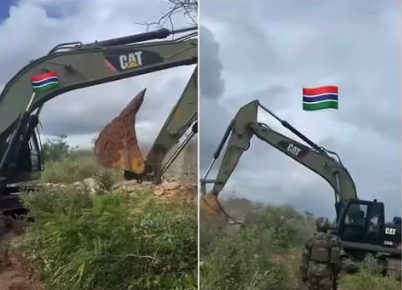
The Senegalese army demolished a perimeter fence belonging to the Gambia Armed Forces near Bulock in Foni Kansala, West Coast Region, on July 21, 2026. This significant incident occurred in an area geographically situated close to the Senegalese border, specifically near Bulock in Foni Kansala, West Coast Region. This action, carried out by Senegalese military personnel, has immediately raised profound concerns regarding the delicate bilateral relations between the two West African nations, Senegal and The Gambia. The nature of the incident, involving the direct removal of military infrastructure belonging to a neighboring state, shows the gravity of the situation and its potential to destabilize regional cooperation.
Unjustified Unilateral Action
The incident involving the fence demolition occurred in the past few days, according to reports available on July 21, 2026. This timing is key as it notes the immediacy of the concerns being raised. The Senegalo-Gambian Permanent Secretariat is the established body specifically designed to address and resolve bilateral issues between the two nations. This mechanism exists precisely to facilitate dialogue, mediate disagreements, and ultimately prevent unilateral actions that could strain relations and undermine mutual trust. The existence of such a formal channel implies an agreed-upon process for handling sensitive matters, making the recent unilateral action particularly perplexing and concerning. The very purpose of the Secretariat is to ensure that both countries have a platform for communication, thereby avoiding escalations that could arise from actions taken without prior consultation or mutual agreement.
Questioning Bilateral Relations
The author of this piece questions the unilateral action undertaken by Senegalese authorities, particularly the decision to demolish the fence without prior consultation or engagement through established diplomatic channels. The Senegalese army's action in Foni Kansala is seen as potentially undermining the very mechanisms designed to foster cooperation and resolve disputes between Dakar and Kanifing, the respective capitals. Such incidents, according to the author, risk eroding the trust essential for strong bilateral ties between neighboring states. The use of military force in a disputed area, even for a perimeter fence, raises concerns about the precedence it sets for addressing future disagreements. This development necessitates a careful re-evaluation of how both nations approach border management and diplomatic engagement moving forward. The author's strong stance reflects a broader apprehension about the implications of such an act on the long-term stability and partnership between Senegal and The Gambia, particularly given the historical and cultural ties that bind the two countries. The principle of sovereignty dictates that actions on one's territory should be respected, and the demolition of a Gambian Armed Forces fence by a foreign army, regardless of the perceived justification, is a direct challenge to this principle.
Potential Repercussions and Sovereign Rights
The recent incident occurred despite the Fourth Senegalo-Gambian Presidential Council having been held in Dakar approximately one month prior to the fence demolition. This high-level meeting is typically a forum for addressing bilateral issues and fostering cooperation between the two nations, providing ample opportunity to discuss any border-related concerns. The fact that such an incident could transpire so soon after a significant diplomatic engagement further complicates the narrative and points to a potential breakdown in communication or a disregard for established protocols. The author suggests that a potential consequence of such unilateral actions could involve the closing of the Senegambia Bridge to Senegalese vehicles. This measure would represent a significant economic and logistical repercussion, impacting cross-border movement and trade between Senegal and The Gambia, and potentially disrupting the livelihoods of countless individuals and businesses. The proposed action shows the potential for diplomatic tensions to escalate into practical barriers, affecting daily life and regional connectivity. Such a move would be a clear signal of the Gambia's dissatisfaction and a demonstration of its sovereign right to control access to its infrastructure, directly in response to perceived infringements on its sovereignty.