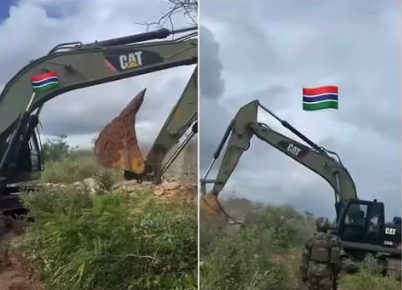
Senegalese soldiers recently dismantled a section of a perimeter fence belonging to a Gambia Armed Forces installation in Bulock. The incident, which occurred on July 16, has prompted the Gambian government to activate the Joint Military Committee, a body established to address and de-escalate tensions along the border between the two West African nations. This action occurred amid heightened sensitivities in the Foni region, specifically near Bulock. The activation of the committee indicates Banjul's intent to formally address the cross-border operation, which the Gambian government reported as having taken place without prior notification.
Border Dispute Escalates
The Gambian government reported that Senegalese troops dismantled a section of the fence at the Bulock installation without providing prior notification. This recent action follows an incident in June 2025, when elders in Bulock raised concerns after Senegalese authorities stopped the construction of a perimeter fence around the same army camp. At that time, Senegal asserted that the land in question fell within its territory. The Senegalese Ministry of African Integration, Foreign Affairs and Senegalese Abroad stated that the area "has, for several years, been the subject of discussions between the competent authorities of both countries." The ministry added that "Despite sustained exchanges at the highest level and long-standing negotiations, these discussions have not, to date, resulted in a clear commitment aimed at durably resolving the outstanding border issues." Senegal has insisted that the incident "cannot be interpreted as reflecting any intention… to undermine the sovereignty of The Gambia or the excellent relations between the two countries."
The incident marks a significant escalation in a long-standing border dispute between the two West African neighbors. The flashpoint, where Senegalese soldiers pulled down part of the perimeter fence, is situated near Bulock in the Foni area, a region that has historically seen fluctuating levels of cross-border activity and territorial claims. The Gambian government's decision to activate the Joint Military Committee shows the seriousness with which Banjul views the unilateral action by Senegalese forces. This committee serves as a key mechanism for dialogue and dispute resolution, aiming to prevent such incidents from further destabilizing the delicate balance along the shared border. The lack of prior notification for the fence's demolition, as reported by the Gambian authorities, is a central point of contention, suggesting a breach of established diplomatic protocols and mutual understanding.
Banjul's Strong Reaction
The incident, which saw Senegalese soldiers dismantle part of a Gambian army camp's fence, occurred on July 16. Following this action, the Gambian government formally opened diplomatic channels, demanding an explanation from Dakar regarding the unilateral demolition. Senegal, in response to the growing tensions, claimed it had repeatedly drawn Banjul’s attention to alleged encroachments affecting its territorial integrity. Dakar further stated that these purported encroachments were the subject of ongoing discussions between the two nations. Despite the recent events, Senegal reiterated its commitment to the peaceful resolution of border disputes. This commitment, Dakar affirmed, would be pursued through continued dialogue and the utilization of existing bilateral mechanisms established between The Gambia and Senegal.
The Gambian government's immediate demand for an explanation notes its concern over the perceived infringement on its sovereignty. The activation of the Joint Military Committee is a clear signal that Banjul intends to address this matter through formal, structured diplomatic and military channels. The committee's role is to facilitate communication and de-escalation, especially in situations where military forces of both nations are directly involved in a disputed area. Senegal's acknowledgment of the Gambian communiqué, while defending its actions, indicates that both sides are now engaged in a formal diplomatic exchange, albeit one marked by differing interpretations of territorial rights and historical agreements. The repeated claims by Dakar regarding alleged encroachments by The Gambia suggest a reciprocal sense of grievance, complicating the path to a swift resolution.
Diplomatic Channels Open
The flashpoint incident, where Senegalese soldiers dismantled a section of a Gambian army fence, is situated near Bulock in the Foni area. Senegal has acknowledged the Gambian communiqué requesting an explanation for the fence's demolition, but the Senegalese government has also defended its actions. Dakar stated that the area “has, for several years, been the subject of discussions between the competent authorities of both countries.”
Senegal claimed that despite sustained exchanges at the highest level and long-standing negotiations, these discussions have not, to date, resulted in a clear commitment aimed at durably resolving the outstanding border issues. The Senegalese Ministry of African Integration, Foreign Affairs and Senegalese Abroad further stated that the incident "cannot be interpreted as reflecting any intention… to undermine the sovereignty of The Gambia or the excellent relations between the two countries." Dakar reiterated its commitment to the peaceful resolution of border disputes through continued dialogue and existing bilateral mechanisms. The Senegalese government's defense rests on the premise that the land in question has been a subject of ongoing, unresolved discussions, implying that their actions were a response to what they consider a persistent issue. This stance, however, directly conflicts with The Gambia's assertion that the demolition was an unannounced and unilateral act. The emphasis on existing bilateral mechanisms by both nations suggests a shared understanding that diplomatic means are the preferred route for resolution, despite the current tensions. The Joint Military Committee and other established channels will now be key in mediating this latest dispute and preventing further escalation between the two West African nations.