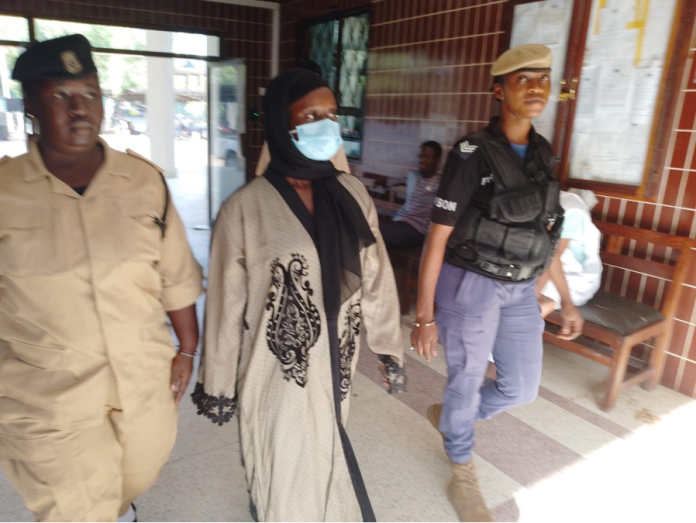
Kumba Sinyan, accused of murder, is undergoing a retrial in The Gambia after the original proceedings were halted despite significant progress. The case stems from the killing of Momodou Lamarana Jallow at the Friendship Hostel nearly four years ago. This tragic event, which occurred almost four years prior, set in motion a legal process that has now become a stark illustration of the Gambian justice system's inherent challenges. Sinyan had already entered her plea and testified across six sessions, enduring both examination and cross-examination during the initial trial. Her extensive participation in the original proceedings, which included presenting her defense and undergoing rigorous questioning, shows the significant time and effort already invested by all parties involved. This substantial progress in the initial trial makes the necessity of a retrial particularly frustrating for those seeking a swift resolution.
The retrial became necessary when a new judge took over the case. Gambian law mandates that an entire trial must restart if the accused does not consent to continue under a different judge. This legal requirement has led to the current situation where the proceedings are effectively beginning anew for Sinyan, forcing her to relive the traumatic experience of trial and prolonging the quest for justice. The implications of such a procedural reset are broad, affecting not only the accused but also the victims' families and the public's confidence in the judicial process.
The Legal Basis for Retrial
Kumba Sinyan’s murder trial must begin again from scratch, a decision rooted in Gambian legal requirements. Justice Sidi K Jobarteh, the original presiding judge, went on maternity leave, necessitating a change in judicial oversight. This change, while a common occurrence in any professional setting, triggered a significant procedural hurdle in the Gambian legal system. The accused did not agree to continue the proceedings with the existing trial record under a new judge. This refusal to consent is a critical factor, as it directly invoked the legal mandate for a complete restart. The Supreme Court upheld this requirement, explaining that it was applying the law faithfully. The highest court in The Gambia, in its ruling, affirmed its commitment to the letter of the law, even if the outcome presents practical difficulties. This decision notes the Supreme Court's role in interpreting and enforcing existing statutes, emphasizing that it was fulfilling its constitutional duty by adhering strictly to the established legal framework.
The Supreme Court specifically affirmed the High Court Practice Directions of 2013 and 2019. These directions mandate a new hearing, or trial de novo, when a new judge assumes responsibility for a criminal case and the accused does not consent to continue from the point where the previous judge concluded. These practice directions are designed to ensure fairness and due process, but in application, they can inadvertently lead to significant delays and inefficiencies. The requirement for a complete restart, or trial de novo, means that all evidence must be presented again, all witnesses recalled, and all legal arguments re-litigated from the very beginning. In The Gambia, serious cases are decided by a single judge, not a jury, which is a factor in these procedural rules. This absence of a jury means that the judge is not only the arbiter of law but also the finder of fact, making the continuity of the judicial mind overseeing the case a more emphasized concern under the current legal framework.
Section 24 of the 1997 Constitution promises a fair hearing and a hearing within a reasonable time for all accused persons. However, for the High Court, where all murder cases are heard, there is no existing rule that allows for continuity when a new judge takes over a case; the default procedure is to restart the trial entirely. This procedural gap directly contradicts the constitutional aspiration for timely justice. The absence of a specific provision for a succeeding judge to smoothly take over a partly-heard case forces the system into an inefficient loop, undermining the very principles of fairness and expedition enshrined in the constitution. This legal framework has led to the current retrial for Sinyan, subjecting her to an extended period of legal uncertainty and emotional strain. The State has indicated that this situation poses challenges, as some witnesses have since left the country, potentially complicating the presentation of evidence. The departure of key witnesses, a common occurrence over extended periods, could severely hamper the prosecution's ability to rebuild its case, potentially jeopardizing the pursuit of justice for Momodou Lamarana Jallow.
Outdated Practices and the 2025 Act
Under the former testimony rule, earlier testimony could be utilized at a retrial if a witness had died or left the country. This rule, designed to prevent the collapse of cases due to unavoidable circumstances, provided a key mechanism for maintaining judicial continuity. However, the application of this rule in the current Gambian context is complicated by the broader requirement for a trial de novo. The Criminal Procedure Act, 2025 has since repealed the old Criminal Procedure Code, which previously governed such proceedings. This legislative overhaul marks a significant shift in The Gambia's legal landscape. The old Criminal Procedure Code had directed that criminal practice in The Gambia follow, as nearly as circumstances allowed, the practice of Her Majesty’s High Court of Justice in England. This historical link reflected a legacy of legal frameworks, demonstrating the enduring influence of colonial legal traditions on the Gambian justice system. This adherence to English common law principles, while foundational, often meant that The Gambia's procedural rules evolved in tandem with, or in response to, developments in the UK. For instance, Michael Sang Correa, a Gambian, was tried in Denver in 2025 for torture committed in The Gambia, showing the international implications of legal consistency and modern procedural adherence. The ability of international courts to prosecute crimes committed elsewhere notes the growing demand for strong and efficient justice systems globally.
The ongoing UTG student murder case faces potential collapse as discovery and fact-finding often barely commence before the first witness testifies, noting a systemic issue within the Gambian justice system. This scenario paints a grim picture of cases languishing, with essential preparatory work either delayed or incomplete, leading to trials that are ill-prepared from the outset. Such delays in the foundational stages of a criminal trial can severely prejudice both the prosecution and the defense, making a fair and speedy resolution increasingly difficult. Recognizing these challenges, the Criminal Procedure Act, 2025 aims to modernize areas such as plea agreements, parole, witness protection, and bail rules. This full legislative effort seeks to bring the Gambian legal framework into the 21st century. Its stated purpose is to “re-enforce the right to fair and speedy trials … by specifying reasonable timelines.” This explicit goal signals a governmental acknowledgment of the current system's shortcomings and a commitment to addressing the protracted nature of legal proceedings. This legislative overhaul seeks to address the inefficiencies and procedural gaps that have impacted cases like Kumba Sinyan's, offering a glimmer of hope for future litigants.
A key provision within the new legislation is Section 345 of the Criminal Procedure Act, 2025. This section allows a magistrate inheriting a partly-heard case to continue using the existing record, a significant departure from the previous mandate for a trial de novo under certain circumstances. This change could prevent situations where trials restart from scratch due to judicial changes, potentially streamlining proceedings and reducing delays in the lower courts. However, this provision applies specifically to magistrates, leaving a critical gap for High Court cases like Sinyan's, where the stakes are highest and the delays most impactful. The new Act represents an effort to bring Gambian criminal procedure closer to international standards and improve the efficiency of its courts, but its effectiveness in addressing the root causes of High Court delays remains to be fully seen.
International Comparisons and Proposed Reforms
Globally, modern legal systems often prioritize efficiency and continuity in criminal proceedings. Modern English courts, for instance, aim to settle difficult issues before trial, with fixed timetables established at a Plea and Trial Preparation Hearing. This proactive approach ensures that trials proceed smoothly, with fewer interruptions and delays. Section 40 of the Criminal Procedure and Investigations Act 1996 in the United Kingdom further specifies that decisions concerning evidence and legal points are made in advance and are binding on the trial judge. This binding nature prevents issues from being re-litigated during the trial itself, saving valuable court time and providing clarity for all parties. The United States employs pretrial conferences, motions to determine admissibility in advance, and the Speedy Trial Act to streamline its judicial process. These mechanisms are designed to resolve evidentiary disputes, narrow the issues for trial, and ensure that cases move forward without undue delay, upholding the constitutional right to a speedy trial. For example, during the trial of Michael Sang Correa in Denver, discovery disputes were settled before trial, and evidence was heard continuously over five days. This continuous hearing of evidence, without the frequent adjournments seen in some other jurisdictions, is a hallmark of efficient judicial systems, allowing for a focused and uninterrupted presentation of the case.
In US law, the concept of "jeopardy" attaching, which prevents retrial for the same offense, occurs at different points depending on the trial type. In a bench trial, jeopardy attaches when the first witness is sworn, as established in Serfass v United States, 420 US 377 (1975). This means that once testimony begins, the defendant cannot be retried for the same crime if the trial is terminated prematurely without their consent. For a jury trial, jeopardy attaches when the jury is sworn in, according to Crist v Bretz, 437 U.S. 28 (1978). These clear rules provide certainty and protect defendants from being subjected to multiple prosecutions for the same alleged offense, embodying a fundamental principle of due process.
Conversely, The Gambia's Criminal Procedure Act, 2025, despite its modernizing intent, still allows for open-ended adjournments under Section 239, rather than mandating continuous trials. This provision, while offering flexibility, inadvertently contributes to the very delays the Act purports to address, allowing for the fragmentation of trials and prolonging the judicial process. Section 19 of the 1997 Constitution states that anyone arrested must be brought before a court within seventy-two hours, but further progress on trials can be slow, revealing a disconnect between the initial promptness of detention and the subsequent pace of justice. This disparity notes a systemic issue where the initial stages of the legal process are relatively swift, but the substantive proceedings often grind to a halt.
To address these systemic issues, the article proposes four key changes for The Gambia: implementing a succeeding-judge rule for the High Court, requiring a pretrial conference, ensuring continuous trials, and establishing clear legal deadlines for speedy trials. A succeeding-judge rule for the High Court would allow a new judge to take over a partly-heard case without a complete restart, building upon the progress already made. Mandatory pretrial conferences would facilitate the early resolution of evidentiary and procedural matters, similar to practices in modern English and US courts. Enforcing continuous trials would minimize adjournments, ensuring that cases proceed without unnecessary breaks, thereby reducing the overall duration of proceedings. Finally, clear legal deadlines for speedy trials would hold the justice system accountable, ensuring that all cases, especially those involving serious crimes like murder, are resolved within a reasonable timeframe. Ultimately, it is up to the National Assembly to provide The Gambia with a law suitable for effective application. The legislative body holds the power and responsibility to enact reforms that truly modernize the justice system, ensuring it serves the people of The Gambia with efficiency, fairness, and adherence to constitutional principles. The Supreme Court did its job by applying the law faithfully, but it is now incumbent upon the National Assembly to give The Gambia a law worth applying – one that prevents the kind of procedural quagmire seen in the Kumba Sinyan retrial.