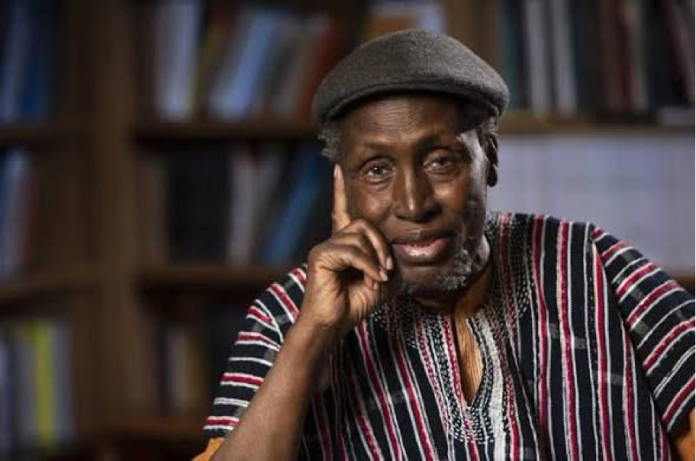
Official tributes quickly followed the death of Ngũgĩ wa Thiong'o, with Kenyan leaders acknowledging his significant contributions to the nation’s intellectual and cultural landscape. President William Ruto designated Ngũgĩ as "Kenya’s greatest man of letters" and "a fearless voice for justice, truth, and African identity." Kenya’s Members of Parliament also honored his impact on the country’s intellectual life. Rarieda MP Otiende Amollo proposed commemorating Ngũgĩ's legacy by naming a public institution after him. This proposal to name a public institution in Ngũgĩ's honor posthumously drew attention to a perceived disparity in recognition during his lifetime, particularly when compared to other African scholars. For instance, an independent research institute affiliated with the University of Ghana in Accra was named after Gambian scholar and author Prof Sanneh while he was still alive and formally inaugurated in 2020. The Sanneh Library, a specialised research library, was inaugurated in 2022 and also named after Professor Sanneh. The Sanneh Library houses around 5,000 books from his personal collection and supports scholarship on Christianity, Islam, and interfaith relations. This contrast shows a broader discussion about how intellectual and cultural figures are honored, both during their lives and after their passing. The swift arrival of these official tributes after his death noted the complex relationship between the celebrated author and his home nation, revealing a pattern of belated recognition for a figure who had long championed Kenyan and African identity on the global stage.
A Life of Struggle and Exile
Ngũgĩ wa Thiong'o endured significant personal and professional hardships throughout his life, including imprisonment without trial. He was subsequently driven into exile and denied an academic future in his native Kenya, while his books and community theatre initiatives faced suppression. His experiences of state repression and forced displacement profoundly shaped his literary output and his unwavering commitment to social justice. During his incarceration, Ngũgĩ penned his novel Devil on the Cross on prison-issued toilet paper, a testament to his continued literary output despite adverse conditions. This act of defiance, writing a major novel under such restrictive circumstances, cemented his image as a resilient voice against oppression. Despite being denied an academic future in his own country, his intellectual contributions were recognized globally. Universities in Britain, Denmark, South Africa, Uganda, Tanzania, New Zealand, and the United States awarded Ngũgĩ honorary doctorates. Notably, no Kenyan university awarded Ngũgĩ honorary doctorates, including the University of Nairobi, an institution where he had previously taught. This lack of recognition within his home country, juxtaposed with widespread international acclaim, notes a complex relationship between the scholar and his nation. The denial of an academic future in Kenya, coupled with the suppression of his literary and theatrical work, forced Ngũgĩ to continue his intellectual endeavors from abroad, yet his influence continued to resonate deeply within literary and academic circles worldwide.
His longtime collaborator, Micere Githae Mugo, shared a similar fate, spending years in exile abroad before her cremation overseas. Following Ngũgĩ's passing, a private family ceremony was held in Gĩtogothi, Limuru, the village of his birth. This intimate gathering preceded a series of public memorial events across different locations. Commemorations were subsequently held in Atlanta, Georgia, and Nairobi, Kenya. The University of California, Irvine, also hosted a memorial event to honor his contributions and legacy. These diverse memorial events, spanning continents and academic institutions, showed the global reach of Ngũgĩ's influence and the profound impact he had on intellectual and cultural communities far beyond his homeland.
The Nobel Snub and Global Acclaim
Ngũgĩ wa Thiong'o received widespread international recognition for his literary achievements, often placing him at the forefront of global literary discourse. For more than a decade, Ngũgĩ wa Thiong'o was regularly listed among the first two favourites for the Nobel Prize in Literature. This consistent positioning as a leading contender showed his profound influence and the high esteem in which his work was held by critics and literary enthusiasts worldwide. In 2020, The New York Times observed that Ngũgĩ had been expected to win the Nobel Prize for years, reflecting a sentiment shared by many in the literary community. Despite the persistent speculation and the strong critical backing, the Nobel Prize ultimately eluded him. This repeated "snub" became a point of discussion among his admirers and commentators, who often viewed it as a missed opportunity for the Swedish Academy to recognize a powerful voice in world literature. The ongoing debate surrounding his consistent nomination and ultimate omission from the Nobel laureates further amplified his stature, cementing his place as a figure whose work transcended mere accolades.
Enduring Literary Power
Ngũgĩ wa Thiong'o's fiction extensively chronicled themes of colonialism, the complexities of independence, the rise of dictatorship, and the ongoing struggle to reclaim African cultural identity. His narratives provided incisive critiques of post-colonial governance and the persistent psychological effects of imperial rule, offering a powerful voice for the marginalized. His momentous study, Decolonising the Mind, significantly transformed academic and public debates concerning language, literature, and the widespread effects of colonial power. In this seminal work, Ngũgĩ argued passionately for the use of African languages in African literature and education, advocating for a cultural liberation from the vestiges of colonial influence. He contended that language was not merely a tool for communication but a carrier of culture, identity, and worldview, and that the continued dominance of European languages perpetuated a form of mental subjugation. His work challenged scholars, writers, and policymakers to reconsider the linguistic landscape of post-colonial Africa, inspiring a movement towards linguistic self-determination and the valorization of indigenous cultures. Ngũgĩ's posthumous legacy extends to his short story, “The Upright Revolution,” which has been translated into more than one hundred languages, demonstrating its global reach and enduring appeal. The widespread translation of this particular work notes its universal themes and its resonance with diverse audiences across different linguistic and cultural contexts. The cremation of Ngũgĩ wa Thiong'o aligned with the principles that shaped his life’s work, concluding a life dedicated to African cultural and intellectual liberation. His commitment to these principles, even in death, served as a final testament to his unwavering belief in the power of African identity and intellectual independence, a belief he articulated through both his profound literary contributions and his personal choices.